
In 2014, Indian football stopped being polite about its ambitions and made a proper spectacle of itself with the launch of the Indian Super League. The Indian Super League arrived with Bollywood stars as co-owners, retired legends on the pitch, and marketing muscle that cricket had enjoyed for decades. Alessandro Del Piero was in Delhi. Roberto Carlos too. Nicolas Anelka, Robert Pires, Freddie Ljungberg. The first season of the Indian Super League felt less like a football league and more like a touring exhibition of football’s greatest hits. And it worked.
For the first time, football was being discussed in cities where cricket had held an absolute monopoly for generations. The crossover appeal was deliberate. Cricket fans who had never watched a football match were suddenly curious.
What the marquee era actually built
The foreign stars did something less visible alongside attracting eyeballs: they set a professional standard. Tactical habits, training intensity, technical quality that Indian players hadn’t been consistently exposed to.
But it was never going to last. Spending millions on ageing superstars for a two-month competition wasn’t building anything permanent. By 2016, organisers recognised that relying on expensive international stars wasn’t sustainable and decided to phase out the marquee player rule, focusing instead on nurturing homegrown talent.
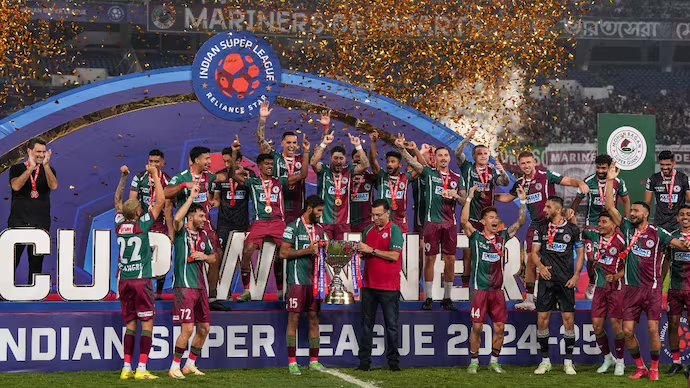
The results show up clearly. In 2014, teams allowed seven foreigners in the XI at any point. Now, teams need seven Indians on the pitch at all times. The top Indian scorer in 2014 managed four goals. By 2022-23, 51 different Indians had found the net across the season. By the 2025 final, nearly 58,000 fans packed Salt Lake Stadium with 5.5 million more watching on television. The Indian Super League had clearly begun to reshape the football landscape in the country.
The messy bit: two leagues, one country, years of chaos
For years, India ran two top-division football leagues simultaneously. FIFA and AFC appointed a committee to address the disarray caused by the two parallel leagues running together, tasked with re-establishing a single league pyramid.
The tension between the ISL, backed by Reliance’s FSDL, and traditional I-League clubs was fierce. It took until 2019 for a roadmap to be agreed, and even then implementation crawled. The promise of relegation, which the AFC explicitly demanded, was repeatedly delayed. The AIFF eventually ignored the AFC’s insistence on implementing relegation from 2024-25, deviating from the roadmap both parties had agreed to in 2019.
Without relegation, there’s no real jeopardy for franchise clubs. No team fights to stay up. No team gets punished for sustained failure. That’s not a football league. That’s a franchise product.
The 2025 crisis
Just when the league had found real momentum, the whole thing stalled. In 2025, an agreement between FSDL and AIFF broke down, putting the Indian Super League season on hold entirely. Clubs paused operations. Players, including Sunil Chhetri and Sandesh Jhingan, put out public statements about the impact on their livelihoods. A FIFA ban, though avoided, was a genuine possibility.
For a league that spent a decade building credibility, it was a damaging moment.
The bottom line
The Indian Super League has professionalised Indian football, built a genuine pipeline of homegrown players, and put the sport on prime time television in a cricket country. That’s real.
But no relegation means no stakes. Governance disputes keep threatening to derail everything every few years. The administrative chaos consistently undermines the on-pitch progress.
The 58,000 fans at the 2025 final proved the appetite is real. The question is whether the people running this league can build a structure that’s actually worthy of it.
Leave a Reply